Project Status
Type of Work
California Global Biodiversity Alliance: Power of Subnational and Local Leadership
Challenge
Nations are struggling to overcome the global biodiversity crisis, especially as short term crises distract from environmental priorities. Yet biodiversity and climate struggles are expected to become the overwhelming priority of nations within 10 years or less, and governments are identifying biodiversity collapse as a primary national security threat. This struggle is compounded by the United States not being party to the UN Convention on Biological Diversity, one of the world’s three seminal environmental treaties. Further, while a whole-of-government and whole-of-society approach is required to successfully and holistically address the biodiversity crisis, many at the subnational and local levels, who are participating in implementing environmental goals, are experiencing challenges. Though a number of subnational and local governments are stepping up to address the biodiversity crisis — individually, collectively, and in cooperation with organizations like ICLEI, Regions 4 and IUCN — additional support for such bottom up “local to global” action is needed, including for subnational and local governments and organizations in the United States.
Response
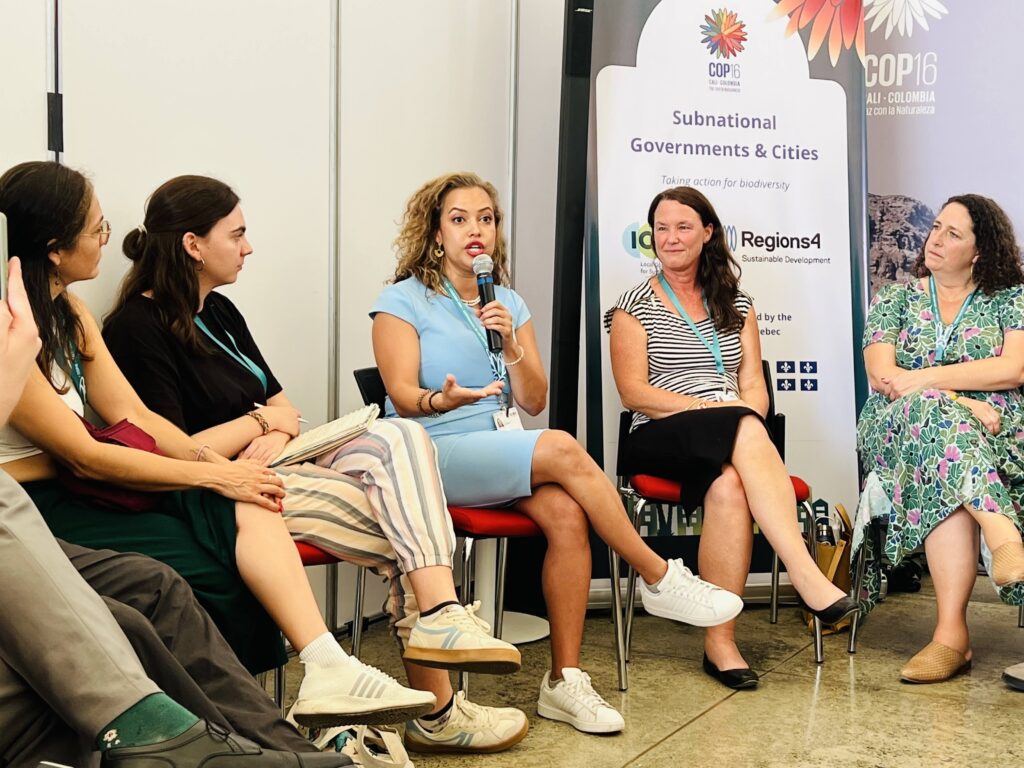
In 2019, Rosalind approached now Congressperson Laura Friedman (then State Assemblymember) to pitch a strategy for California to become a subnational biodiversity leader on the global stage. Friedman became a champion for this effort, and with her support as well as the collaboration of California Environmental Voters, Rosalind co-founded a coalition — now known as the California Global Biodiversity Alliance (CalGBA) — of leading local, state and national organizations in California to advocate for California to become an official observer to the UN Convention on Biological Diversity. This effort was successful, but didn’t stop there. A collaborative “delegation of delegations” from California, including over 50 state elected officials, city government representatives and NGO and research leaders attended the CBD COP15 in Montreal, Canada, and this group expanded to over 100 for COP16 in Cali, Colombia.
In order to address subnational and local biodiversity goals implementation challenges, CalGBA members and partners engagement is strategic, well-coordinated, co-creative and highly inclusive. Between CBD COPs, CalGBA is led by a member driven Steering Committee to conduct outreach and education around integration of the Global Biodiversity Framework’s (GBF) 23 Targets into policies and planning. This has resulted in a California StoryMap as well as an initiative to gather case studies from states, cities, counties, Tribal governments and NGOs that see their work as GBF aligned. Serving as a common language for a holistic approach to environmental policies, CalGBA partners and members have become the advocates for GBF alignment. The LA County Youth Climate Commission, for example, requested that the county, which represents over 10 million people, align with the GBF, become a CBD observer, and join CalGBA. This was formally adopted by the LA County Board of Supervisors. Collaborating with national partners including ICLEI USA, the Global Biodiversity Youth Network USA, IUCN North America, and the National Caucus of Environmental Legislators, CalGBA also launched a dialogue series to generate national conversation amongst subnational and local governments on how to collectively overcome challenges for biodiversity / environmental policy and how to engage with the CBD COPs and GBF as a guiding framework and forum for generating important exchange and partnership development. Besides local benefits, CBD engagement is leading to beneficial exchange and partnerships at the global level and strengthening global work on subnational and local leadership for biodiversity, overall. This is also reflected in state-to-state leadership with California state — as a result of becoming a CBD observer — joining the Subnationals Task Force of the High Ambition Coalition for Nature and People, participating in subnational leadership with Regions4 and joining the IUCN during the World Conservation Congress.
CalGBA members are also highly active in CBD COP preparation leadership, serving on both an overall COP17 Planning Committee and on a set of subgroups inclusive of Tribal Government Engagement, Environmental Justice Communities Engagement, Case Studies Development, Policymakers and Government Engagement, Academia and Research and planning for trainings, workshops and other education opportunities as well as COP logistical coordination. These groups also actively engage elected officials and government representatives, a number of whom will attend COP and be encouraged to mainstream biodiversity in their work and policies. This movement is continuing to grow at a rapid pace, showing a strong appetite for effective, highly functional and inclusive coalition work.
Participants
- CalGBA’s multi-stakeholder membership, inclusive of local governments, Tribal governments, California statewide NGOs, US national NGOs and coalitions, universities, community led organizations, research institutions, and others.
- California state government (under the California Natural Resources Agency and Ocean Protection Council) — as a partner.
- Global subnational governments — as partners.
- Global NGOs — as partners.
- The CBD Secretariat — as a collaborator.