Project Status
Type of Work
Convening a Global Partnership: Connecting Grassroots and Governments
Challenge
Global multi-stakeholder partnerships that bridge grassroots organizations and governments, as well as other stakeholders such as NGOs, Indigenous peoples, philanthropies, finance institutions, other UN agencies and the private sector, often struggle to foster inclusiveness, co-creation and non-hierarchical approaches. Differences in organization size or how well resourced they are, as well as their approaches to leadership and engagement may also present challenges for collaboration.
In 2022, Rosalind became the Thematic Lead of the Feminist Action for Climate Justice (FACJ) Action Coalition, which is convened by UN-Women under their Generation Equality Forum. The coalition comprises over 150 organizations, including national governments, that have made commitments to advance feminist action for climate justice at different scales. The coalition also connected these diverse groups and facilitated collective action and learning opportunities.
FACJ Action Coalition leadership presented an opportunity to enact innovative approaches to overcoming challenges for global multi-stakeholder partnerships, and to enable diverse stakeholders to meaningfully collaborate and utilize participatory approaches while flattening hierarchies.
Response
Overcoming challenges to effective and inclusive coalition engagement that, in particular, bridged government and grassroots organizations, was rooted in the coalition’s overarching goals and facilitated dialogues (both virtual and in person) that provided enough structure and opportunities to listen while not being overly formal. These dialogues built trust and shared objectives between coalition members that led to collaborations for knowledge sharing, partnered space in global forums and events, and strategic planning. Also vital to the coalition’s success was a commitment to a safe space for meaningful co-creation and a healthy means to work through disagreement. These spaces were also deliberately intergenerational.
A few of the successful, strategic collaborations that resulted from this approach included:
- “A Call to Action: Empowering Youth Voices with FACJ Action Coalition Commitment Makers” was a youth-led intergenerational virtual workshop that resulted in strategic goals and next steps for youth leadership within the coalition that informed the coalition’s growth and outreach.
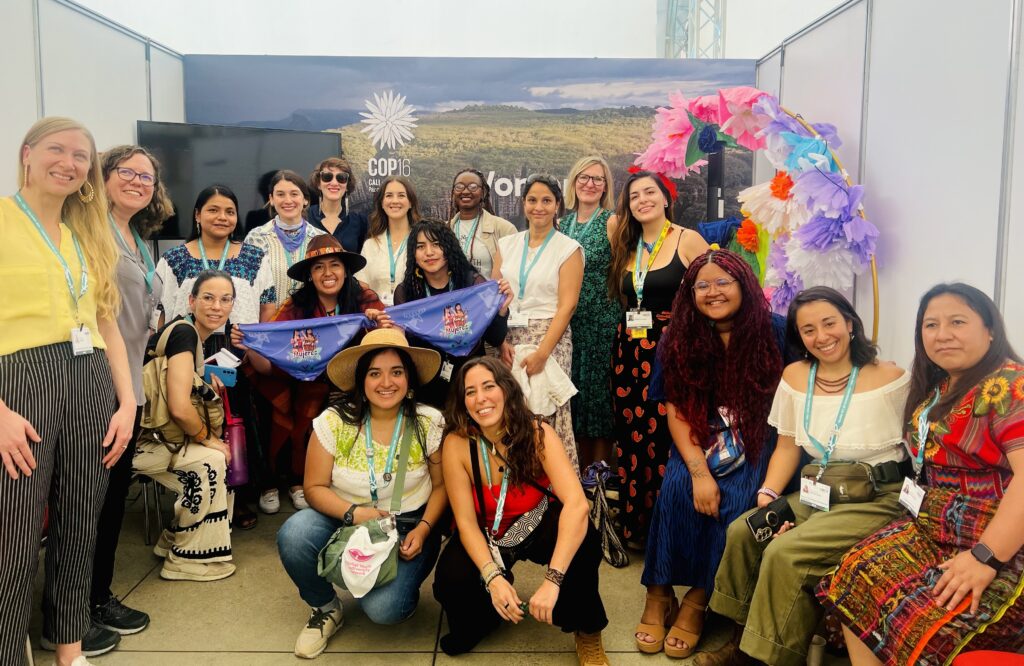
- At the UNFCCC COP28 FACJ Action Coalition youth leaders took a particularly prominent role in gender-just climate action related dialogues with the Nordic Council of Ministers and Government of Spain.
- At Stockholm +50, FACJ Action Coalition youth leaders, governments, UN-agencies and NGOs gathered for an informal dialogue on the sidelines facilitated by the youth leaders.
- At CSW 68, FACJ Action Coalition government members, youth, grassroots leaders and NGOs convened to co-launch “55 Stories of Change.”
- The FACJ Action Coalition “Fundraising Strategies for Small, Grassroots Women and Youth Organizations Advancing FACJ Commitments” workshop brought together youth, UN agencies, governments, finance institutions, and philanthropies to share and co-create tips, ideas and strategies to advance commitments made under the coalition.
- Numerous other facilitated dialogues strengthened non-hierarchical exchange and collaborative priorities setting under the coalition.
Participants
- Members of the Feminist Action for Climate Justice (FACJ) Action Coalition (grassroots-led and local organizations, Indigenous-led organizations, youth-led organizations, NGOs, UN-agencies, philanthropies, development banks, finance institutions, private sector, etc.)
- Additional partner organizations, including governments and UN-agencies